Interview
Yang Wen-Ke
Hsinchu County Cultural Foundation, Taiwan
Yang Wen-Ke, Magistrate of Hsinchu County, drives both innovation and cultural preservation. As Chairman of the Cultural Foundation, he promotes “craftsmanship as a cultural language,” bringing traditional arts into modern daily use.
1 Congratulations on your achievements in the MUSE Creative Awards! Could you start by introducing yourself or your agency? Can you also share a bit about your journey into your current industry?
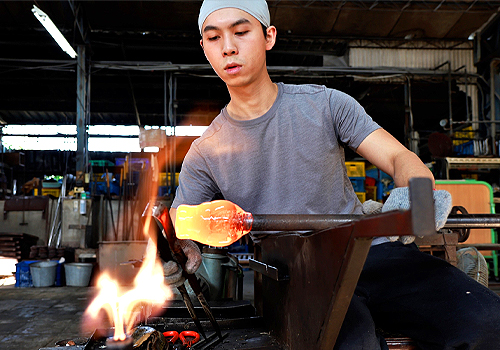
I am Yang Wen-Ke, an elected Magistrate of Hsinchu County. A significant portion of my public service career has been dedicated to promoting the development of our region’s science parks and semiconductor industry clusters. The other half has been devoted wholeheartedly to advancing the long-term prosperity of my hometown, Hsinchu County, for the next 30 years. I also serve as the Chairman of the Hsinchu County Cultural Foundation. Since its establishment in 1993, the Foundation has continuously undertaken the mission of promoting cultural policies and art education in Hsinchu County. Although it once operated at a limited level due to insufficient resources, it was relaunched and reformed in 2019 under the guidance of the county government. Our key inspiration for pursuing cultural design lies in the belief that “craftsmanship is a cultural language.” We recognize the value of traditional crafts such as wood carving, bamboo weaving, glasswork, and bronze ware, and through design reinterpretation, we aim to help these crafts move beyond display cabinets and become cultural expressions that can be used and felt in everyday life.
2 What inspired you to submit your work for this competition, and what does winning mean to you personally and professionally?
For us, winning the MUSE Creative Awards is an important international recognition, symbolizing that Hsinchu County’s cultural initiatives are now part of a global conversation. “Dream of Craft” has been held for three consecutive years since 2023, attracting over 400 submissions from various regions, including young designers, traditional masters, and academic institutions. Over the past three years, we have invested more than NT$5 million in resources, building a three-in-one mechanism that brings together exhibitions, branding, and sales channels. Being able to step onto the international stage and share the innovative energy of our craftsmanship with the world marks a significant milestone for cultural sustainability.
3 Can you share the story behind your success? What inspired its creation, and what do you feel it represents in today’s industry?
Many people believe that design is a momentary flash of inspiration, but in reality, it is a long-term process of integration. It requires understanding cultural context, mastering the language of craftsmanship, exploring material possibilities, and undergoing market and user validation. The core message that “Dream of Craft” aims to convey is this: design is not an exhibit placed behind high walls — it should be a cultural companion in people’s everyday lives. The ultimate goal of the brand is cultural dissemination. It serves as an important tool for the Foundation to implement cultural policies and nurture local creative energy, rather than focusing solely on market sales. Only when a design can be used, cherished, and passed on does it truly fulfill its mission.
4 What do you believe set your project apart in such a competitive field? Were there specific elements or strategies that made it shine?
The most unique source of inspiration in our competition comes from overlooked everyday materials. For example, coconut tree leaves found on campus — originally just fallen waste — were transformed into vibrant flower vessels by a creator, showcasing the harmony between sustainability and craftsmanship. Another piece, “Hearing and Perception,” grew out of the lived experience of a hearing-impaired creator, who reimagined a hearing aid accessory as an elegantly handcrafted brass ornament that is both practical and beautiful. These inspirations may seem ordinary, but precisely because they come from daily life, they create the most genuine cultural resonance.
5 Every project has its challenges. Can you share a significant obstacle you faced during this process and how you overcame it?
The biggest challenge was finding a way to help traditional craftsmanship gain real acceptance in contemporary society. Many people view crafts as collectibles or exhibition pieces, with little practical value. Our approach has been to encourage collaboration between young designers and traditional masters, transforming craftsmanship into designs that meet the needs of modern life. For example, integrating bamboo weaving into home furnishings or reimagining glass craftsmanship as storage boxes and other functional pieces. Through exhibitions, brand partnerships, and international exchanges, we bring these works into the market. The process is not easy, but it has successfully shifted craftsmanship from something meant only for “viewing” to something meant for “using.”
6 Winning an award of this caliber often brings recognition. What do you hope this achievement will mean for your career, your team, or your agency in the long run? Have you already noticed any changes or opportunities arising from this recognition?
This achievement has significantly strengthened the Foundation’s visibility and social impact. Over the past three years, our exhibitions have attracted more than 10,000 visitors, and over 200 related media reports have helped us successfully connect public cultural promotion with market channels. The award not only introduced “Made in Hsinchu” to an international audience but also created opportunities for global collaboration, including twin-city exchanges with Sumida City in Tokyo, Japan, to jointly showcase craft design achievements. For participants, the greatest opportunity is seeing their works officially launched under the “Every Day a Good Day” brand, entering bookstores, exhibition venues, and lifestyle retail spaces.
7 What has the reaction been from clients, audiences, or stakeholders about your winning entry? Any feedback or memorable moments that stand out?
While profitability can support brand operations, its greater value lies in building long-term confidence in cultural development and strengthening public understanding and appreciation of local culture. We hope that through this platform, young designers and traditional masters can have a meaningful space for exchange, allowing their works to move from creation and exhibition into everyday life. Culture should not remain behind display cabinets — it should become something people can use, share, and willingly pass on in daily life.
8 For those aspiring to achieve similar success, what advice would you offer to help them not only thrive in their industries but also craft compelling, award-worthy entries? Are there specific practices, mindsets, or strategies you believe are key?
Our biggest breakthrough lies in breaking away from traditional ways of thinking in policy promotion. The process often requires continuous communication and explanation, but we uphold the perseverance and resilience embedded in our cultural roots, knowing that only through persistence and steady commitment can real reform and innovation take shape. At the same time, we believe that inspiration comes through exchange, which is why we often overcome bottlenecks through cross-disciplinary and international collaboration. For example, in 2024, we co-hosted a joint exhibition with Sumida City in Tokyo, Japan, allowing “Made in Hsinchu” to stand in dialogue with Japanese craftsmanship. This year, we will continue to deepen global connections, including holding a cultural exhibition at Taoyuan Airport earlier this year, participating in a design exhibition in Finland in September, and exhibiting in Tokyo in December. These cross-cultural experiences not only allow our team to encounter different forms of artistic expression but also bring new perspectives and creative inspiration. When creators step out of familiar environments and immerse themselves in another cultural setting, new sparks often emerge.
9 The creative industry is constantly evolving. How do you view these changes, and where do you hope to position yourself in the future?
The shifts in the creative industry reflect the rapid transformations of society and technology. Digital platforms, artificial intelligence, and cross-disciplinary collaborations are reshaping how we communicate and preserve culture. I see this not as a challenge, but as an opportunity. In the future, I hope to position myself — and the Hsinchu County Cultural Foundation — as a culture-driven innovation platform: one that safeguards traditional crafts and arts while embracing new media and global exchange. In this way, we can protect our cultural roots while bringing local creativity onto the world stage.
10 Entering awards can be daunting for many, especially those just starting out. What would you say to individuals who have limited experience, or are hesitant to showcase their work in competitions? How can they build confidence and see the value in participating?
I would advise young designers to courageously begin with their own land and culture, because the most moving designs often come from the familiar things we tend to overlook. Do not be afraid to experiment, and do not limit yourself with market expectations too early. Stay creative and open-minded, while also cultivating respect for craftsmanship and an awareness of sustainability. When cultural stories are combined with contemporary aesthetics, design gains both depth and reach, allowing it to go further. This is the message I most want to share with the new generation of creators.
11 Creativity thrives on community. What message would you like to share with fellow creatives, marketers, and advertising professionals?
Creativity is born from sharing and connection. Without community, even the best ideas struggle to grow. My message to fellow creatives, marketers, and advertising professionals is this: bring your ideas into the community and let them collide with people’s experiences, emotions, and cultures. Only then can we create work that truly resonates — not just adding value to products, but shaping culture and leaving a lasting impact.
12 Winning is a team effort in many cases. Is there someone or a group of people you’d like to dedicate this achievement to, and why?
I would like to dedicate this honor to the artists, craftsmen, performing groups, and the many volunteers of Hsinchu County. Culture is never the work of one individual; it is the collective effort of people who have rooted themselves in this land, giving their passion and time. It is their persistence and teamwork that allow us to step onto the global stage and let the world witness the strength of Hsinchu.
13 If you could describe your award-winning entry in one sentence, what would it be and why?
If I were to describe our winning work in one sentence, I would say: “It is a piece written with craftsmanship as the pen and culture as the paper, telling the story of Hsinchu’s spirit.” It embodies the dedication of traditional artisans and the creativity of our time, with every detail carrying the warmth of our land and people. This recognition is not only a tribute to the work itself, but also an encouragement to all cultural guardians and craft masters who keep traditions alive.
14 Finally, what’s next for you? Any exciting projects or upcoming goals that you’d like to share with us and the audience?
Looking ahead, we will continue advancing our “30-Year Cultural Blueprint,” supporting new generations of artists and craftsmen while strengthening international exchanges to bring Hsinchu’s culture to the world. We are also planning digital platforms to preserve and promote local crafts, allowing global audiences to experience the unique beauty of Hsinchu online. I believe Hsinchu County will become one of the most culturally resilient regions in the world, recognized internationally through its crafts and culture.